
Download G*Power – Statistical Power Analysis, Effect Size Calculation, Sample Size Determination
Overview
G*Power is a specialized statistical tool designed to support researchers in conducting power analyses across a broad spectrum of statistical tests, including t tests, F tests, χ² tests, z tests, and certain exact tests. The application is particularly valuable for individuals involved in academic research, experimental design, and data analysis within the social, behavioral, and natural sciences. By enabling users to compute statistical power and determine the required sample size, G*Power helps prevent underpowered studies, which can lead to inconclusive results and wasted resources. The tool also facilitates the calculation of effect sizes, providing researchers with a deeper understanding of the practical significance of their findings.
Developed by the University of Düsseldorf, G*Power is recognized for its academic rigor and reliability. The application serves as a critical component in the research methodology toolkit, supporting both novice and experienced researchers in making informed decisions about study design. Real-world use cases include planning clinical trials, designing psychological experiments, and evaluating the feasibility of large-scale surveys. Its ability to visualize results graphically enhances interpretability, making complex statistical concepts more accessible. G*Power contributes significantly to methodological transparency and reproducibility in scientific research, aligning with growing demands for robust statistical practices in academia.
Key Features & Functionality
- Comprehensive Power Analysis – Supports a wide range of statistical tests, allowing users to compute power or sample size for t tests, F tests, χ² tests, z tests, and specific exact tests. This functionality ensures applicability across diverse research domains.
- Effect Size Computation – Provides accurate calculation of effect sizes, a key metric for assessing the magnitude of observed differences or relationships in data. This supports researchers in interpreting the practical relevance of their findings beyond mere statistical significance.
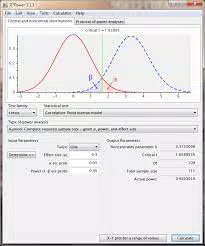
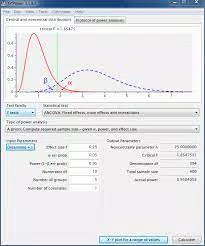
- Graphical Result Presentation – Displays power analysis outcomes in visual formats such as power curves and distribution plots. These graphical outputs enhance understanding and facilitate communication of results in academic papers and presentations.
- User-Friendly Interface – Features an intuitive layout that simplifies navigation and input of parameters. Even users with limited statistical training can perform complex analyses with minimal learning curve.
- Flexible Output Options – Allows users to export results in various formats for integration into reports, manuscripts, or further analysis in other software.
For example, a psychology researcher preparing a study on cognitive performance might use G*Power to determine the minimum sample size needed to detect a medium effect with 80% power at a 5% significance level. Similarly, a biostatistician planning a clinical trial could use the tool to evaluate the impact of varying sample sizes on the study’s ability to detect treatment effects. The integration of visual feedback ensures that users can quickly assess trade-offs between power, sample size, and effect size.
Interface, UX & Performance
The interface of G*Power is clean, functional, and focused on core analytical tasks. It uses a tabbed layout to organize different test types, input parameters, and output results, allowing users to switch seamlessly between analysis modes. Navigation is straightforward, with clearly labeled fields for effect size, significance level, power, and sample size, enabling efficient input and iteration. The visual elements are minimal but effective, emphasizing clarity over ornamentation.
Although the developer did not list formal performance metrics, the application runs efficiently on standard desktop systems, with responsive interaction and quick calculation times. The lack of animations or heavy graphics contributes to stable performance across different hardware configurations. The tool maintains consistent behavior during repeated use, with no reported instability or crashes in standard usage scenarios. Users can expect smooth operation when performing multiple analyses or adjusting parameters in real time.
Compatibility with Windows, macOS, and Linux ensures broad accessibility for academic institutions and individual researchers. The absence of external dependencies or background processes enhances reliability. The developer did not provide additional technical details about system requirements or optimization for low-end devices.
Platform Compatibility & Technical Requirements
G*Power is available for Windows, macOS, and Linux, making it accessible to users across major operating systems. The current version is 3.1.10, with a file size of 28.7 MB, indicating a lightweight and efficient installation. The application is free to download and use, with no in-app purchases or subscription models. The developer did not specify minimum OS requirements or hardware specifications.
Given the file size and cross-platform availability, G*Power is designed for use on standard desktop computers rather than mobile devices. The absence of mobile versions suggests it is intended for desktop-based research workflows. Users should ensure their system meets general desktop computing standards for running such software, though specific requirements were not listed.
Pros and Cons
Pros
- Free to download and use, making it accessible to students and researchers with limited budgets.
- Supports a wide range of statistical tests critical for academic research.
- Provides accurate effect size calculations, enhancing methodological rigor.
- Offers graphical visualization of power analysis results for improved interpretation.
- Available on multiple platforms, including Windows, macOS, and Linux.
Cons
- Not available as a mobile app; limited to desktop environments.
- Developer did not provide detailed system requirements or performance benchmarks.
- Interface may appear outdated to users accustomed to modern software aesthetics.
- Requires some understanding of statistical concepts for optimal use.
- Does not include real-time collaboration or cloud-based features.
FAQ
Is G*Power safe to download and use?
Yes, G*Power is developed by the University of Düsseldorf and distributed through official academic channels. It is a free, open-access tool with no known security risks when downloaded from trusted sources.
Can I use G*Power on my smartphone or tablet?
No, G*Power is not available for mobile platforms such as Android or iOS. It is designed exclusively for desktop operating systems including Windows, macOS, and Linux.
Is G*Power updated regularly?
The current version is 3.1.10, released on March 4, 2024. While the developer has not specified an update schedule, the tool remains actively used in academic circles and is considered stable.
Do I need to pay to use G*Power?
No, G*Power is completely free to download, install, and use. There are no hidden fees, subscriptions, or in-app purchases.
Can I install G*Power on multiple devices?
Yes, since the tool is free and not license-locked, users may install it on multiple desktop systems for personal or academic use, provided they comply with the terms of use from the official source.
Final Thoughts
G*Power stands out as a vital tool for researchers committed to methodological precision and statistical robustness. Its ability to perform comprehensive power analyses, calculate effect sizes, and present results graphically makes it indispensable in academic and scientific settings. The user-friendly interface lowers the barrier to entry for researchers at all levels, while the cross-platform availability ensures broad accessibility. Although it lacks mobile support and modern UI aesthetics, its core functionality remains unmatched in the free research software landscape.
For students, academics, and professionals in psychology, education, medicine, and related fields, G*Power offers a reliable foundation for sound experimental design. It empowers users to make data-driven decisions that enhance the validity and impact of their work. With its free access and proven utility, it continues to be a cornerstone in research methodology training and practice.
Download G*Power now


